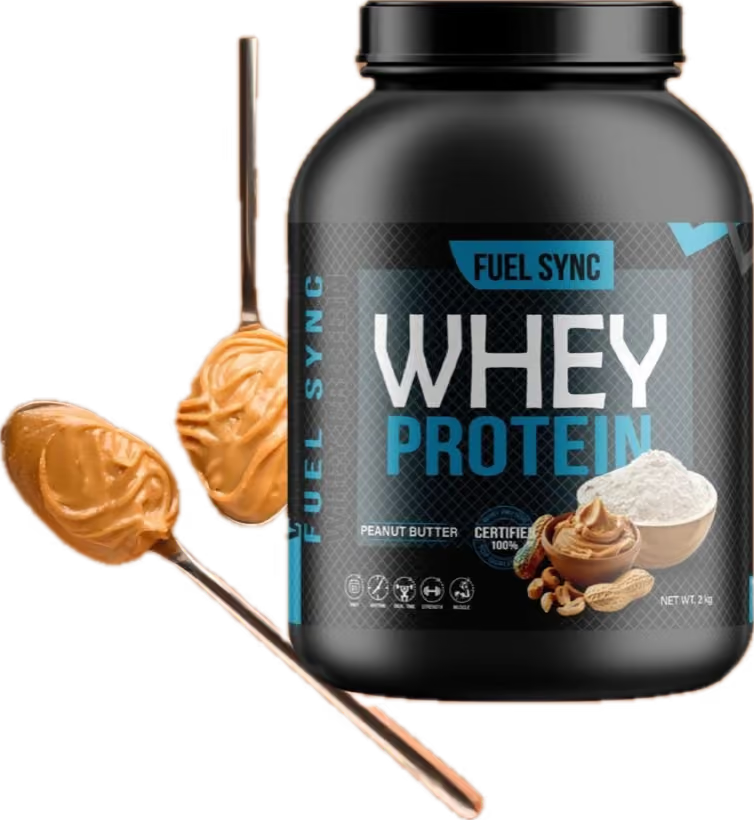
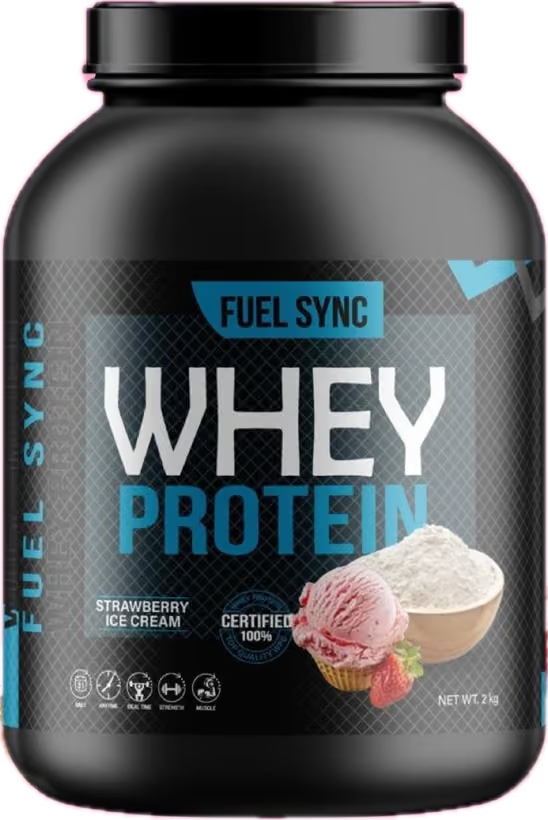
How and when to take whey protein is simpler than most advice makes it. Take one or two scoops a day, mixed with water or milk, whenever it helps you reach your protein for the day. After training is a good default, but your total protein across the day matters far more than the exact minute you drink a shake.
This guide covers how much to take, when, what to mix it with, how to use it in food, and what to do if it doesn't agree with you, using the figures on Fuel Sync's whey label.
How much whey protein to take
Take one or two scoops of whey a day, depending on how much protein your meals already give you. Our protein calculator shows how much you need a day.
Work it out in three steps:
- Find your daily target. People who train usually need 1.4 to 2.0 g of protein per kg of body weight a day, according to the International Society of Sports Nutrition. For a 75 kg person, that's about 105 to 150 g.
- Count what your meals give you. A chicken breast has about 30 g, two eggs about 12 g, a pot of Greek yoghurt about 15 to 20 g.
- Fill the gap with whey. One scoop of Fuel Sync whey adds 22 g. Two scoops add 44 g.
Most people's meals fall 20 to 40 g short, which is one or two scoops. Whey is there to top up food, not to replace it.
When to take whey protein
The best time to take whey is when it helps you reach your daily protein. Research reviews, including a 2013 meta-analysis in the Journal of the International Society of Sports Nutrition, found that total daily protein matters more than timing.
That said, a few times work especially well:
- After training. A shake within an hour or two of training helps your muscles start repairing. It matters most if you trained on an empty stomach, such as first thing in the morning.
- With breakfast. Many breakfasts are low in protein. A scoop in porridge or a shake alongside toast fixes that.
- Between meals. A shake mid-afternoon keeps you full and spreads your protein through the day.
- Before bed. Fine if it doesn't disturb your sleep or stomach. Whey digests faster than casein, but it still adds to your daily total.
On rest days, keep your protein up. Your muscles repair and grow on rest days too, so if your meals fall short, have your usual shake at any time that suits you.
A daily plan for training and rest days
Here's how one or two scoops fit into a typical day:
Training day (one scoop)
- Breakfast with protein: eggs, yoghurt or a scoop in your porridge.
- Lunch and dinner with a palm-sized portion of protein each.
- One shake within an hour or two after training.
Training day (two scoops)
- One scoop with breakfast.
- One shake after training.
Rest day
- The same meals.
- One shake at whatever time fills the biggest gap, often mid-afternoon.
At one scoop a day, a 2 kg tub of Fuel Sync whey (66 servings) lasts just over two months. At two scoops a day, it lasts about a month.
Water or milk?
Mix whey with water or milk, whichever suits your goal and your stomach.
- Water: lighter, fewer calories, and digests a little faster. Best if you're cutting or if milk doesn't agree with you.
- Milk: creamier, more filling and more protein. 400 ml of semi-skimmed milk adds about 14 g of protein and 190 kcal, so a whey shake made with milk gives about 36 g of protein.
Frixos's clients split about evenly. At home many use milk, and when they're out they use water because it's easier to carry and find.
Fuel Sync's label says to mix one level scoop with 400 ml of liquid and drink it straight after mixing. Less liquid makes a thicker shake; more makes it lighter.
How to mix whey without clumps
Whey clumps when the powder hits the liquid all at once. To avoid it:
- Pour the liquid in first, then add the scoop.
- Shake for 15 to 20 seconds with the lid on tight.
- Use room-temperature or cold liquid, not hot.
If you use a blender, add ice or fruit after the whey has mixed in. Rinse your shaker straight after you finish, especially in summer, so it doesn't start to smell.
Using whey in food
Whey works in food as well as shakes, which makes it easier to spread protein through the day.
- Porridge and oats: cook the oats first, let them cool for a minute, then stir in a scoop with a splash of milk.
- Yoghurt: stir half a scoop into Greek yoghurt for a thick, high-protein snack.
- Pancakes and baking: swap some of the flour for whey. Cooking changes whey's texture, not its protein, so you still get the grams.
- Hot drinks: whey clumps in boiling liquid. Mix the scoop with a little cold milk into a paste first, then add warm (not boiling) coffee or milk.
With ten flavours, from vanilla and chocolate to pistachio and salted caramel, there's one for most recipes. For ideas, see our 10 protein shake recipes, one for each flavour.
If whey doesn't agree with you
Most people digest whey easily, but some feel bloated after a shake. Try these, in order:
- Switch to water. This is the usual fix Frixos sees: it is generally the milk, not the whey. Milk adds lactose on top of the small amount in whey concentrate.
- Have a smaller shake. Half a scoop with a meal is easier on your stomach than a full scoop on its own.
- Drink it more slowly. Gulping a shake also means swallowing air.
- Try a whey-free protein. If dairy is the problem, beef protein isolate has no milk in its ingredients (its label notes it may contain traces of milk), and vegan protein is plant based. Our whey vs beef guide compares them.
Storing your whey in the Cyprus heat
Keep your tub below 25°C, in a cool, dry place out of the sun. That's the storage instruction on the label, and a Cypriot summer runs well above it.
- Store it indoors, not in the car or the gym bag.
- Close the lid tightly after every scoop, so humidity doesn't make it clump.
- Use a dry scoop.
Common questions about taking whey
How many scoops of whey protein a day?
One or two for most people. Each scoop of Fuel Sync whey gives 22 g of protein. Take what fills the gap between your meals and your daily target.
Can a protein shake replace a meal?
Not on its own. A shake has protein but little fibre, few vitamins and fewer calories than a meal. For a quick meal, blend a scoop with milk, oats and a banana.
Should I take whey before or after training?
Either works. After training is the most common choice. If you train on an empty stomach, have it after.
Can I take whey protein on rest days?
Yes. Your muscles keep repairing on rest days, so keep your protein up. Have your shake at any time.
Can I take whey every day?
Yes. Whey is a food made from milk, and taking one or two scoops a day is safe for healthy adults. If you have kidney disease, speak to your doctor about your total protein.
Can I mix whey with creatine?
Yes. Add one scoop of pure creatine to your whey shake. Our guide to creatine and whey together explains how.
Get your whey
Fuel Sync whey protein gives 22 g of protein per scoop in ten flavours, with 66 servings per 2 kg tub. Not sure whey is the right protein for you? Read our guide to buying protein in Cyprus.