EAA vs BCAA is an easy choice once you know what's in each. BCAAs are three amino acids: leucine, isoleucine and valine. EAAs are all nine essential amino acids, including those three. Your muscles need all nine to build new muscle, so EAAs do everything BCAAs do and more.
This guide explains the difference, what the research says, and when an amino acid supplement is worth taking, with the figures from Fuel Sync's EAA label.
What are EAAs and BCAAs?
Essential amino acids (EAAs) are the nine amino acids your body can't make, so they must come from food or supplements: leucine, isoleucine, valine, lysine, phenylalanine, threonine, histidine, methionine and tryptophan.
Branched-chain amino acids (BCAAs) are three of those nine: leucine, isoleucine and valine. They're called branched-chain because of their shape. Leucine is the most important of the three, because it signals your muscles to start building.
So every EAA product contains BCAAs, but a BCAA product contains only three of the nine.
EAA vs BCAA: which builds more muscle?
EAAs are better for building muscle, because muscle is made from all nine essential amino acids, not three.
Leucine switches muscle building on, but your body still needs the other six essential amino acids to finish the job. When you take BCAAs alone, it has to borrow those six from its own muscle tissue, which limits how much new muscle it can make. That's why the 2017 review by Robert Wolfe concluded BCAAs on their own can't increase muscle building in a meaningful way.
EAAs supply all nine together, with the leucine to switch building on and the rest to complete it.
What's in a scoop of Fuel Sync EAA
Here's one 8.6 g scoop of Fuel Sync EAA, from our label:
- Leucine: 2,567 mg
- Valine: 1,130 mg
- Lysine: 1,130 mg
- Phenylalanine: 924 mg
- Threonine: 770 mg
- Isoleucine: 461 mg
- Histidine: 359 mg
- Methionine: 256 mg
- Tryptophan: 102 mg
That's 7.7 g of essential amino acids in total, of which 4.2 g are BCAAs. In other words, one EAA scoop gives you a BCAA dose close to many BCAA drinks, plus the six amino acids they leave out. We chose EAA over BCAA so the range covers all nine essential amino acids in one tub, instead of asking you to pick between several products.
Do BCAAs do anything?
BCAAs can reduce muscle soreness slightly in some studies, and some people like a flavoured BCAA drink during training. But for building muscle, they're the weaker choice: you're paying for three amino acids when your muscles need nine.
If you already use BCAAs and like them, switching to EAAs gives you the same three plus the rest, in the same kind of light, flavoured drink.
When EAAs are worth taking
EAAs are worth taking when you need amino acids without a full meal or shake. For example:
- Training fasted, such as early morning before breakfast. A scoop before or during the session gives your muscles amino acids without a heavy stomach.
- Long sessions, such as football, padel or a long gym session, when a light drink is easier than a shake.
- Between meals, when you want something that isn't another protein shake.
- With a lower-leucine protein, such as beef or plant protein, to top up the leucine.
- When your appetite is low and a full protein shake feels like too much.
If you already eat 1.4 to 2.0 g of protein per kg of body weight a day and take a whey shake, EAAs add little. Our guide do you need EAAs if you take whey? explains when they do.
How to take EAAs
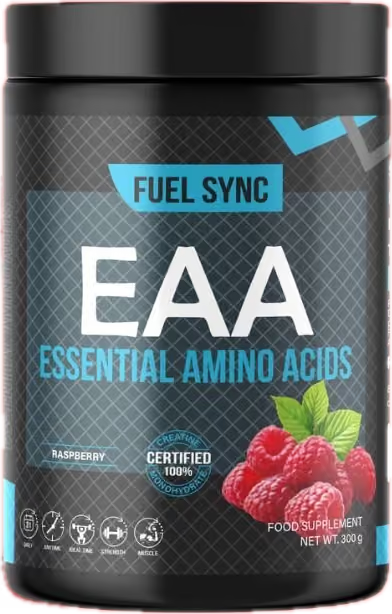
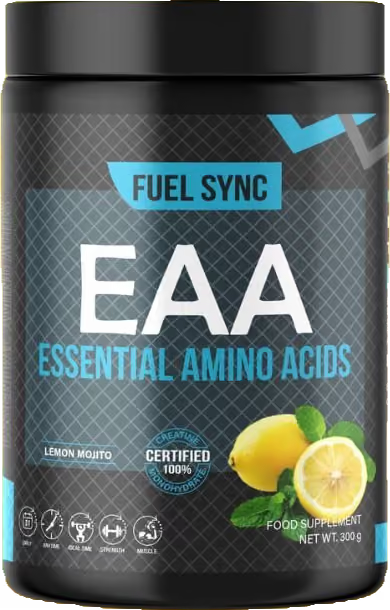
Mix one 8.6 g scoop of Fuel Sync EAA with 200 ml of water and drink it before, during or after training, or between meals. It's a light, flavoured drink in lemon mojito or raspberry, not a thick shake.
In the Cyprus heat, an EAA drink during a long session also means you're drinking water while you train. Keep drinking plain water too.
Common questions about EAAs and BCAAs
Should I take EAA or BCAA?
EAA, for almost everyone. It contains the three BCAAs plus the six other essential amino acids your muscles need to build new tissue.
Can I take EAA and BCAA together?
You can, but there's little point. An EAA already contains BCAAs: one scoop of ours gives 4.2 g of them.
Do EAAs break a fast?
Strictly, yes. Amino acids contain energy and trigger an insulin response, so they aren't a true zero-calorie drink. If you fast for training reasons rather than religious ones, many people take EAAs during fasted training anyway.
Are EAAs better than whey?
Not for most people. Whey contains all nine essential amino acids plus the non-essential ones, and gives more total protein per scoop. EAAs are lighter and faster, which suits specific moments, such as fasted training.
Do EAAs have calories?
Yes, a small amount. Amino acids provide energy like any protein, but a scoop of EAA is far lighter than a shake.
Try Fuel Sync EAA
Fuel Sync EAA gives all nine essential amino acids, 7.7 g per scoop with 2.5 g of leucine, in lemon mojito or raspberry, with 34 servings per tub.